
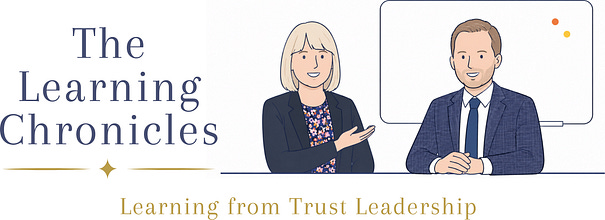
Procedural Knowledge vs Conceptual Understanding- Why can't they apply learning?
In our previous post, we explored why successful performance is not always the same as learning. This week, we go deeper: why knowing the method is not always the same as understanding the concept


There is something wonderful about Google Maps.
At the click of a button, we can be shown a precise route to almost anywhere. This weekend, while navigating my way through London to a coffee shop, guided entirely by my phone, I found myself thinking about the days of opening an A to Z map and having to plan the route myself.
If I tried to recreate that journey now, without Google Maps, I think I would probably manage it. A few memorable markers have stuck: a turning, an interesting building, a familiar corner. I have learned the route.
But knowing the route is not the same as understanding the place.
If you asked me to find a different destination nearby, or gave me an unfamiliar starting point, would I be able to find my way with confidence? Probably not. I might eventually bumble around and work it out, but that would be through luck, persistence or chance rather than genuine understanding.
The same question matters in teaching.
When we give learners a structured route through their work, what have they learned? Have they learned only the steps to follow, or have they begun to understand the map beneath the method?
What is procedural knowledge?
Procedures are powerful. They help learners organise complexity. They reduce unnecessary cognitive load. They give learners access to tasks that might otherwise feel overwhelming. In mathematics, a clear method can help a learner move through a problem with confidence. In writing, a structure can help a learner construct an essay with a clear argument. In science, a sequence can help a learner approach an investigation systematically.
Procedures are not the enemy of understanding. But they are not the same thing as conceptual understanding either.
This distinction matters because learners can become fluent in the visible moves of a task without fully understanding the ideas that make those moves meaningful. They may know what to do next, but not why it comes next. They may know which sentence starter to use, but not what kind of thinking that sentence is meant to support.
They have learned the route. They may even be able to recreate it at a later date, showing it has been learned. But they may not yet understand the place.
So how might this look?
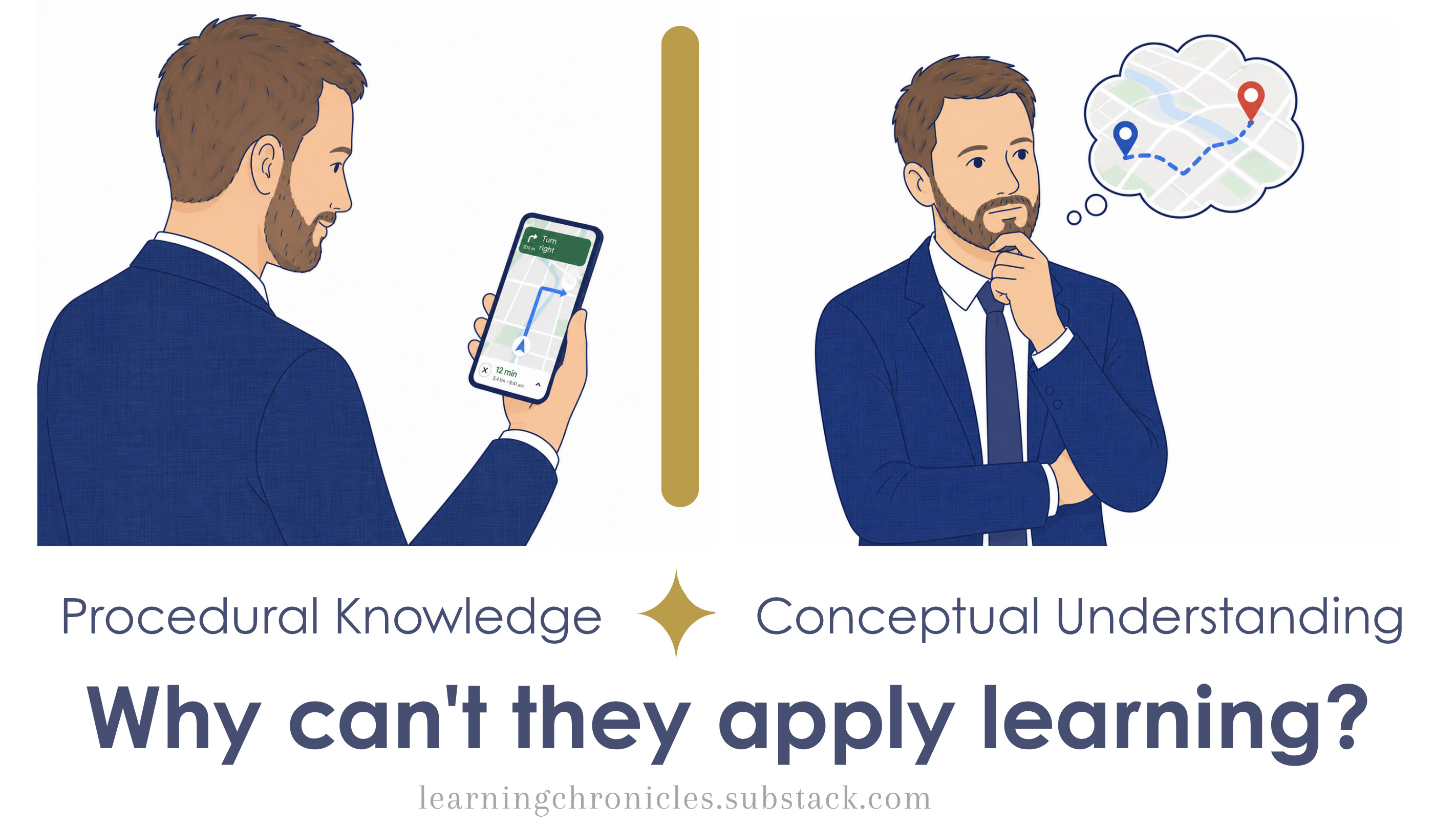
The model below helps to distinguish between three forms of classroom evidence that can sometimes look similar on the surface:
temporary performance
procedural knowledge
conceptual understanding
Each represents a different stage in how securely and flexibly learners can use what they have been taught. The key question is not simply whether learners can complete the task, but whether they can retain, explain, adapt and transfer their learning when the scaffold is removed or the context changes.
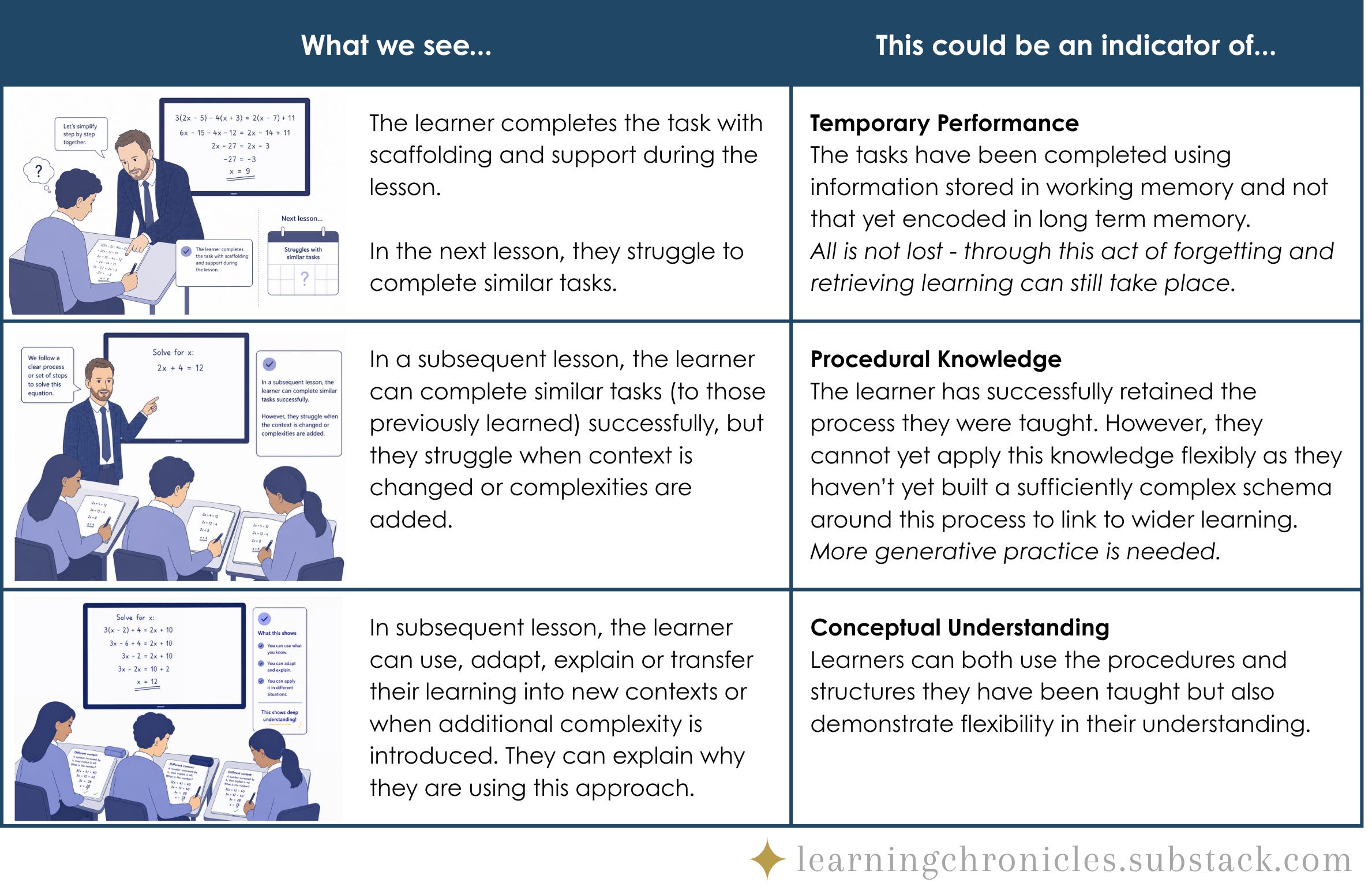
In the context of the Google Maps analogy:
Procedures and concepts grow together
It would be easy to turn this into a simple argument: procedures bad, concepts good. That would be wrong.
Procedural knowledge and conceptual understanding are not enemies. They are partners. They grow together. Sometimes understanding a concept helps a learner use a procedure more intelligently. Sometimes practising a procedure helps a learner notice a concept more clearly.
So what is the problem…
The problem is not practice.
The problem is practice without opportunities to practice the why.
The problem is not modelling.
The problem is modelling without explanation of the concept underlying the steps or model.
The problem is not scaffolding.
The problem is scaffolding that never sufficiently fades.
The best teaching does not force us to choose between fluency and understanding. It seeks both. It recognises that learners need secure knowledge, repeated practice and clear procedures, but it also insists that these should open the door to deeper thought.
Highly scaffolded teaching can help learners acquire procedures. That matters. But a learner who can follow a procedure is not necessarily a learner who understands the concept beneath it. The danger is not procedure itself. The danger is mistaking procedural success for conceptual understanding.
It would be easy to assume this is mainly a problem in procedurally rich subjects such as mathematics. But it is not. From experience of observing learning across a range of contexts, you often see this problem arise in creative subjects too. The Design and Technology lesson where learners are making a product and can tell you the steps they are following to make their product, how to use the equipment safely, but can’t explain how they have designed the item or apply this learning to other products. The Food Technology lesson where learners are following their recipe but can’t explain why they have selected these ingredients or what the steps of the recipe achieve.
This is a problem for all areas of the curriculum if we want our learners to leave, with rich conceptual understanding, able to apply their knowledge in unfamiliar ways.
What teachers can look for
If we want to know whether learners are developing conceptual understanding, we need to look for more than completion. To achieve conceptual understanding after procedural fluency, teachers need to make relatively small changes to what they do.
What might teachers ask of learners…
We might ask learners to explain why a method works.
We might ask them to compare two examples and identify what is the same and what is different, and why one may be better.
We might show a completed answer and ask where the thinking is strong or where it breaks down.
We might ask them to choose between methods and justify their choice.
We might ask learners to generate their own example, non-example or misconception.
What might teachers do differently…
We might modify our exposition to include the why as well as the what - balancing for cognitive load this could be split into two sequences of explanation.
We might provide learners with annotated examples, identifying the reason behind steps or choices.
We might provide more frequent opportunities for turn and talk or other oracy approaches, enabling learners to explain their steps.
We might remove part of the scaffold and listen carefully to what happens next.
These moments give us richer evidence. They reveal whether learners are simply moving through a familiar sequence or whether they are beginning to understand the relationships that give the sequence meaning. They also help learners see learning differently.
The map beneath the method
Great teaching often begins with clarity.
Here is the model.
Here are the steps.
Here is what success looks like.
Let us practise together.
Now you try.
There is nothing wrong with this. In fact, it is often exactly what learners need.
But great teaching does not end there.
It moves from modelling to meaning. From support to independence. From accurate completion to flexible understanding. From “I can do this one” to “I understand this kind of problem”. From “I know the sentence starter” to “I know what this sentence is trying to achieve”. From “I followed the method” to “I understand why the method works”.
That journey is at the heart of learning.
Because the deepest success is not when learners can reproduce what we have shown them.
It is when they can use what we have taught them with confidence, judgement and care in places we have not yet taken them.
A method can help a learner move forward.
But understanding helps them find their way.