

Performance vs Learning - Why don't they remember


There is a moment in many lessons when everything appears to be going well. The explanation has landed. The model has been followed. Learners are answering questions and producing the work we hoped they would. It looks like learning is happening.
And it may be. But it may also be something different: temporary performance.
But how can learners demonstrate performance if they have not learnt anything? Surely, they must have learnt it if they can complete the task. While it may seem like a matter of semantics, the difference between understanding, performance and learning is essential for teachers to understand.
In their 2015 paper, Soderstrom and Bjork describe learning as a lasting change in memory, knowledge or skill, while performance is what we can observe and measure during instruction. The problem is that temporary performance in a task can be a poor proxy for whether durable learning has actually taken place.
What do we mean by temporary performance?
Temporary performance is what learners can show in the moment. It is the answer they can give while the explanation is still fresh, while the model is still visible, and while the scaffold is still in place. It is based solely, or substantially, on recently acquired information stored in working memory. The teacher imparts information which is stored in working memory and this is used to complete a task. Working memory is not permanent, it is finite in capacity and time limited.
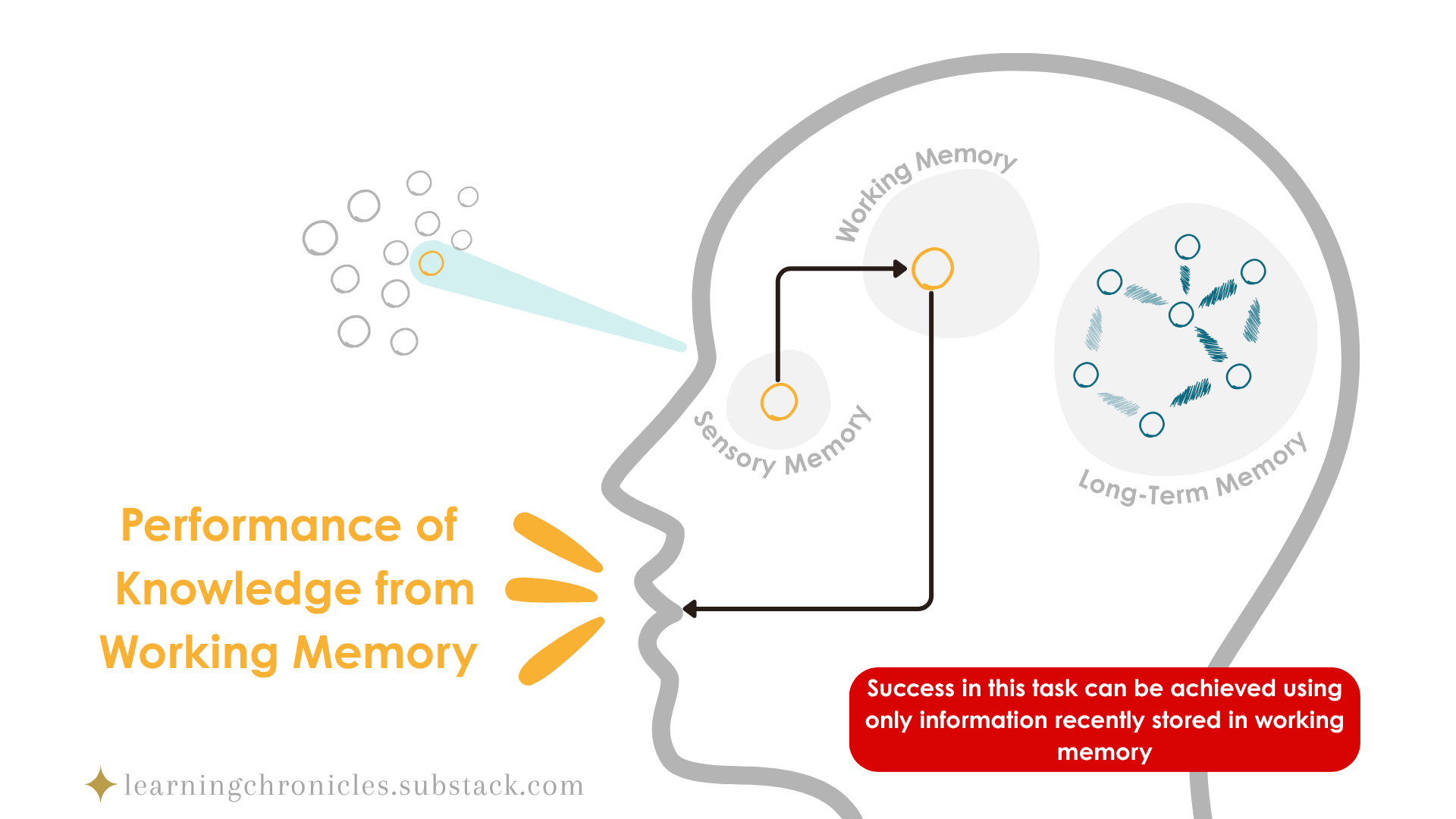
With careful scaffolding and exposition, learners build understanding during a lesson using information stored in working memory. Learners can demonstrate this understanding through performing tasks. For instance, in a maths lesson, a teacher might expertly model a method using a visualiser.
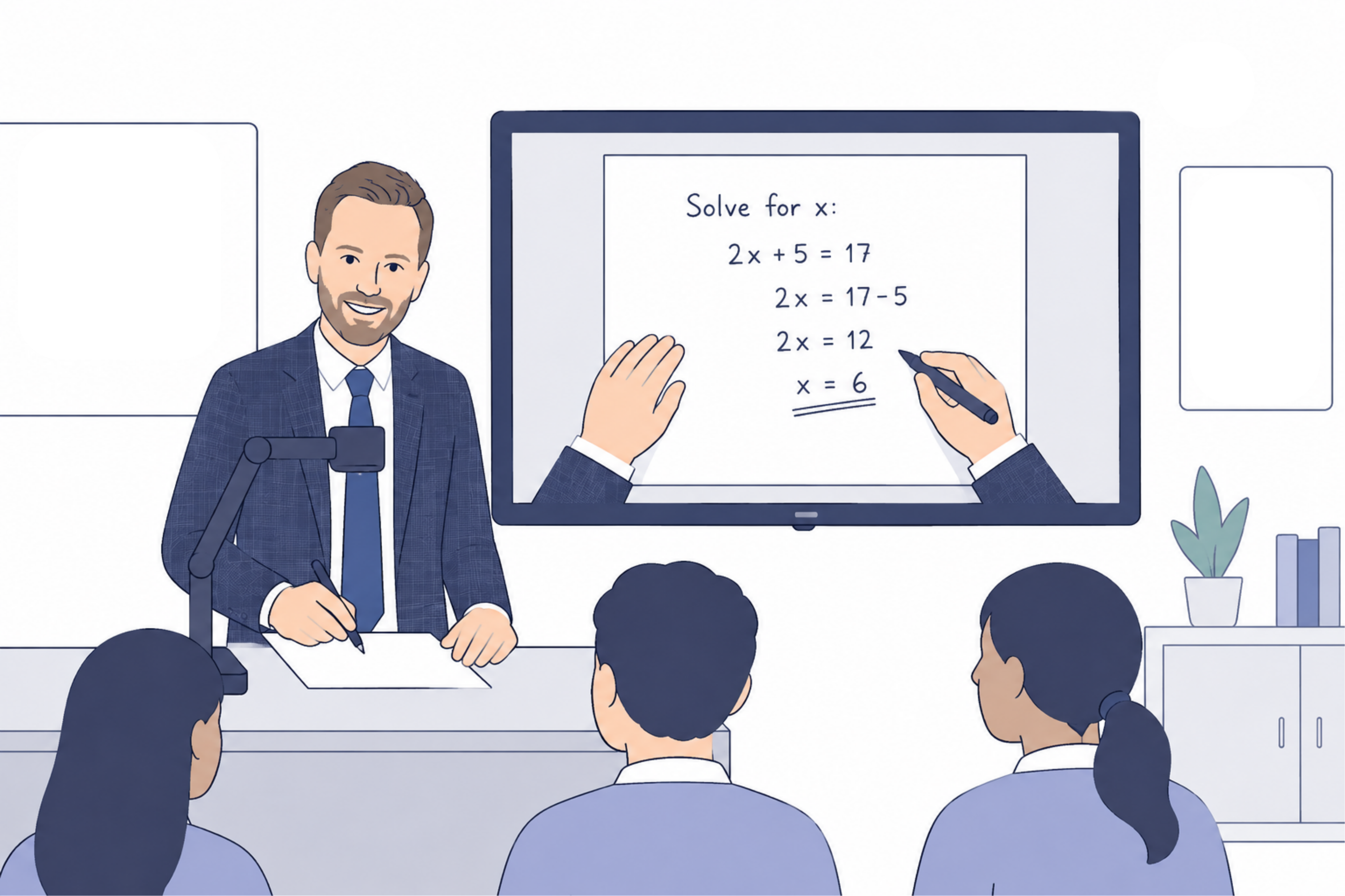
Learners then complete very similar questions with the model still visible and scaffolding in place.
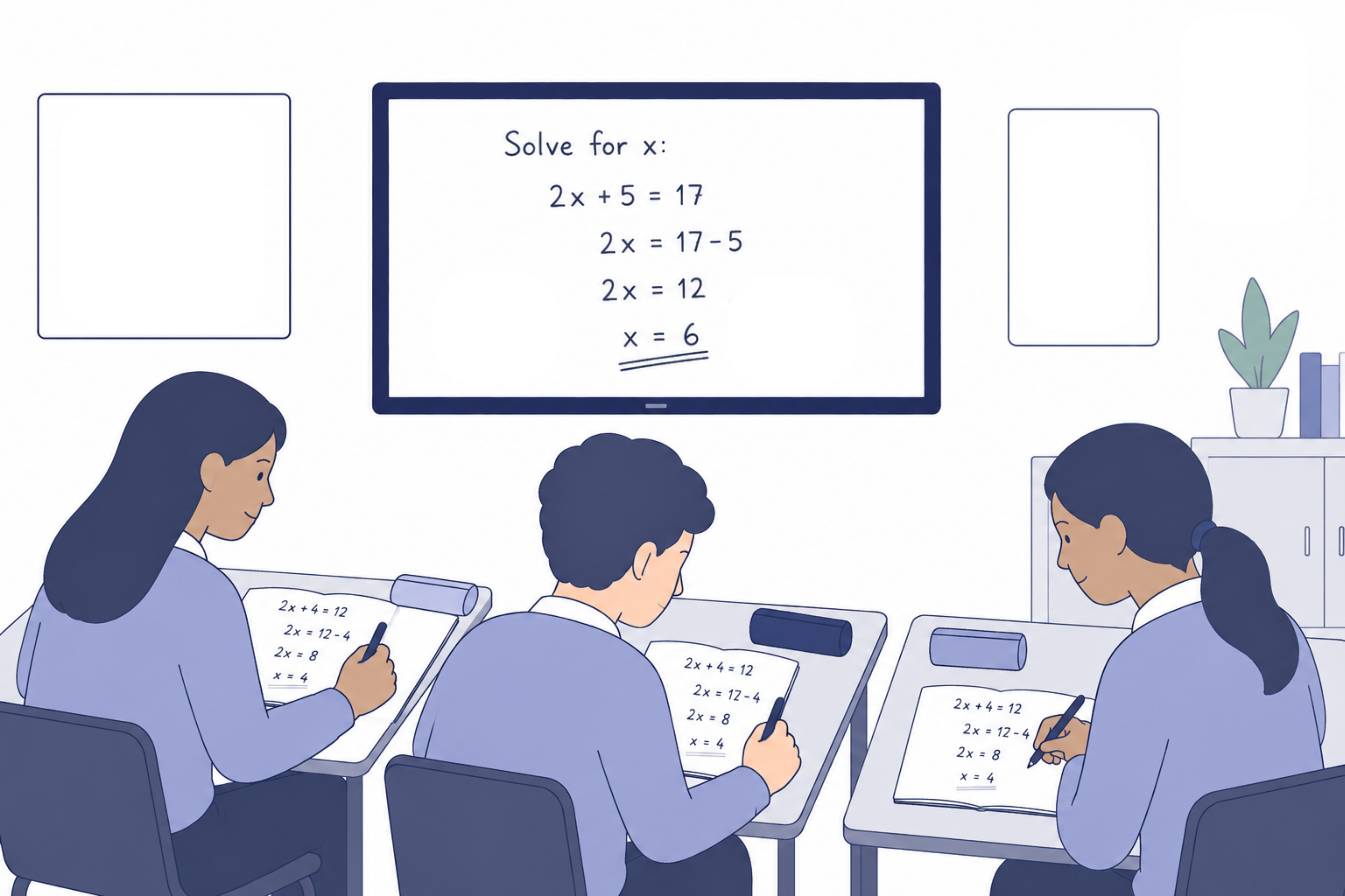
The aim of the teacher is to support learners to engage well, and they do. The learners complete the task. They get questions right. The procedural information they need to complete the task is in their working memory — but this does not inevitably lead to learning.
How is learning different?
Learning is a change in long-term memory. It is what remains when the immediate support has gone. It is what learners can retrieve, use and apply later, in a new lesson, with a different question, in a less familiar context. When retrieval from long-term memory is a prerequisite for performance in a task, learning can be more genuinely assessed.
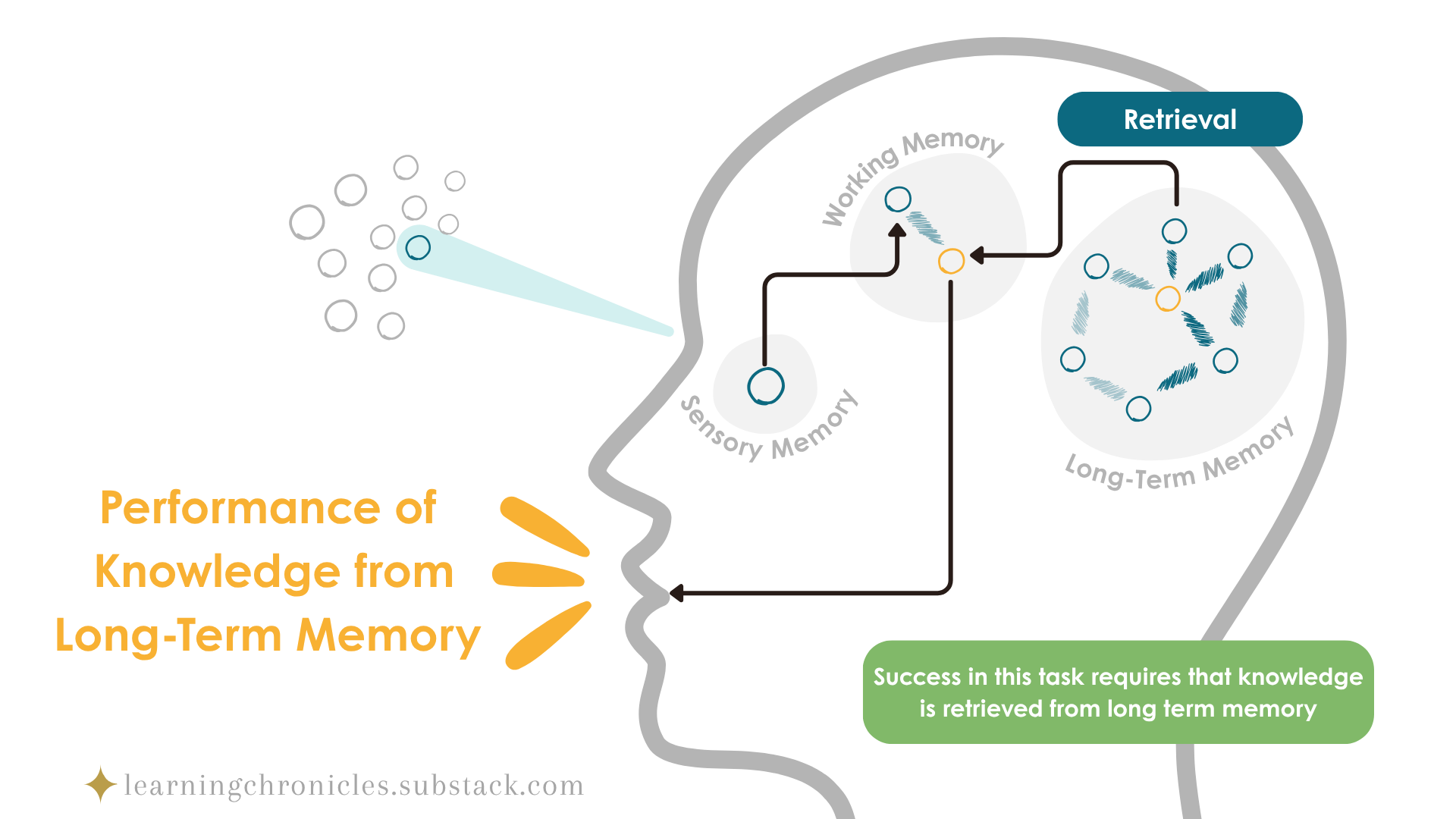
This is why momentary success in a lesson can sometimes mislead us. Learners can perform because the information is still active in working memory. They may be leaning heavily on recent explanation, cues, prompts, worked examples or the structure of the task itself. In that moment, they may look secure. But if the knowledge has not been encoded into long-term memory, it may not be available tomorrow, and therefore has not yet been learned.
This is not a criticism of performance. In fact, performance matters enormously
Understanding leads to Performance
Before learners can securely learn something (encode it in long-term memory) they first need to understand it. And understanding often shows itself through performance. If exposition, modelling and guided practice have not led to some level of successful performance, then the content has not yet been understood.
Perhaps the explanation was not clear enough. Perhaps the model moved too quickly. Perhaps the task introduced too much complexity too soon. Perhaps the prerequisite knowledge was missing.
This is where checks for understanding are so important. They allow teachers to find out whether learners are with them before moving on - through precise questions, examples, non-examples, short tasks and explanations that reveal whether the information has been understood.
Temporary performance, then, is valuable because it gives us evidence of understanding. It tells us whether learners have understood enough to proceed. It helps us diagnose the cause when they have not. It allows us to adjust, reteach, remodel or return to missing prior knowledge. Without this kind of momentary performance, teaching becomes guesswork.
Where we go wrong as teachers is that we check for understanding but think we have checked for learning. The distinction is critical.
What needs to happen after understanding?
Once learners have shown that they understand, the teacher’s attention has to shift.
The question is no longer simply: can they do it now?
The better question is: what will help them do it later?
This is where the work of encoding begins. If knowledge is to move beyond working memory and become part of long-term memory, learners need practice.
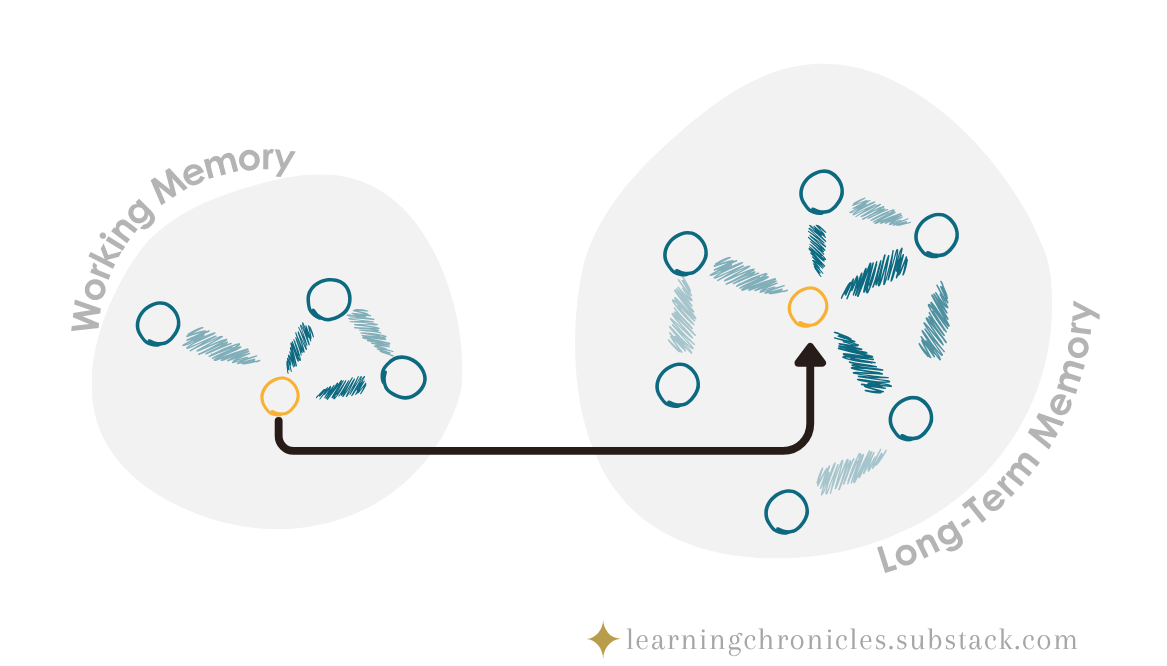
But not just any practice. Not performance that depends on the teacher doing most of the thinking. Not repetition that allows learners to copy the surface pattern or procedure of the example without processing the underlying idea.
They need practice that is increasingly independent.
That means the gradual removal of scaffolds. It means careful sequencing. It means tasks that are well-paced enough to maintain engagement, but demanding enough to require genuine cognitive processing. It means learners having to think, not simply follow. If all of the learners complete their independent/deliberate practice with identical outputs (the same answers) - then it is probably not independent.
This is uncomfortable, because genuine thinking often brings uncertainty with it. Learners may not get every question right. They will struggle. But that is desirable.
I was fortunate to hear Jon Coles, CEO of United Learning, speak at a recent ResearchED event. He proposed a simple model of: teach, check, confuse. Once we have checked that learners have understood, it is the job of the teacher to provide opportunities for confusion or cognitive challenge - in a safe and supportive way.
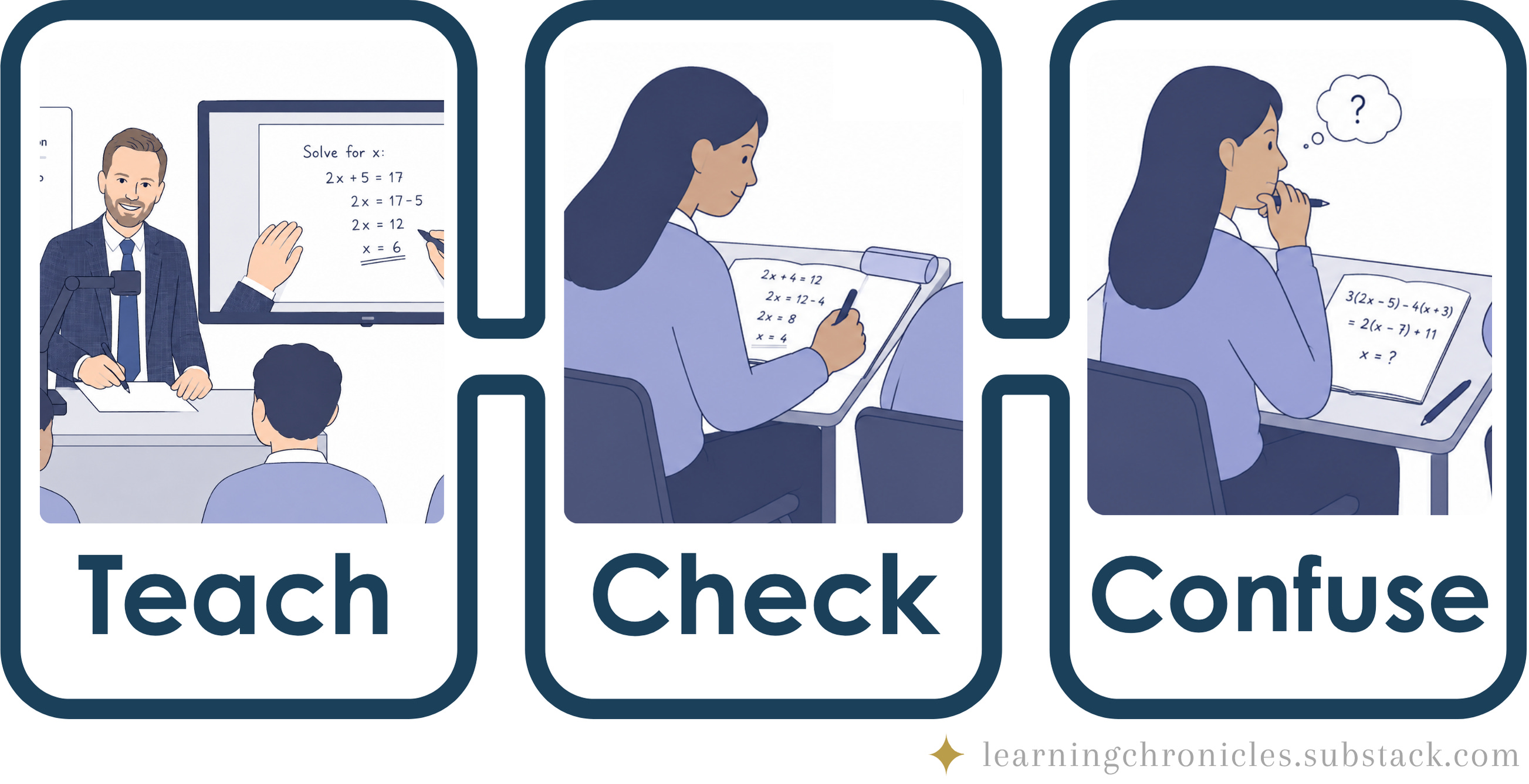
This is a useful lens for thinking about classroom practice. If practice is too easy, too familiar, or too heavily scaffolded, learners may perform fluently without doing the kind of thinking that strengthens memory.
There should be moments where learners have to pause. Where the next step is not immediately obvious. Where they have to decide which knowledge is relevant. Where they have to distinguish between two similar ideas. Where they have to notice a misconception, explain why an answer is wrong, or apply what they know in a new context.
In other words, practice should create the right kind of difficulty.
Not confusion for its own sake. Not cognitive overload. Not tasks that leave learners stranded. But enough difficulty that learners have to retrieve, connect and apply knowledge, rather than simply repeat what has just been shown. A well-designed question can reveal understanding, but it can also support the process of encoding information in long-term memory.
So, what might this look like?
To ensure learning occurs and information is encoded in long-term memory, teachers can:
get learners to interrogate knowledge from multiple directions
ask learners to explain a concept forwards and backwards
change the diagram slightly and ask what is different, getting learners to process information in unfamiliar formats
present a misconception and ask learners to diagnose and explain it
alter the context, remove a cue, vary the numbers, change the example, or ask learners to compare two possible answers
build in discussion and processing time, not as an add-on, but as part of the learning process
ask learners to rehearse an explanation, justify a decision, or identify the exact point at which an argument breaks down
The aim is not simply to see whether learners can reproduce what was just explained. The aim is to find out whether they can use it.
Then comes the real test.
We allow the knowledge in working memory to disappear. We remove the scaffold. We move on. Time passes.
And then, in the next lesson, we return.
Can they still do it?
Can they retrieve the knowledge without the same cues? Can they recognise the structure beneath a different surface? Can they apply the idea when the diagram has changed, the wording is unfamiliar, or the teacher is no longer guiding each step?
This is where we get closer to evidence of learning.
Not perfect evidence, because learning is always inferred. But stronger evidence than performance in the moment. A learner who can return to knowledge later, retrieve it, adapt it and use it with increasing independence is showing us that something more durable may have happened.
Perhaps this is a useful shift in planning.
Instead of asking only, “What do I want learners to do in this lesson?”
We might ask, “What do I want learners to be able to do next lesson, when I am no longer helping?”
Most importantly, it reminds us that the aim of teaching is not successful performance in front of us.
The aim is learning that lasts when we are no longer there.
Great food for thought, I'm wondering if there is a bit more nuance to this?
Current neuroscience views recall as a process of dynamic reconstruction, rather than a storage system.
From this perspective, maybe a student's failure to recall later isn't because information wasn't stored, but because they only learned how to rebuild the knowledge using the teacher's routines.
If students construct the pattern themselves (productive struggle) perhaps the learning becomes more resilient because the scaffolding is personally salient and built in.
I'm interested in your thoughts.